
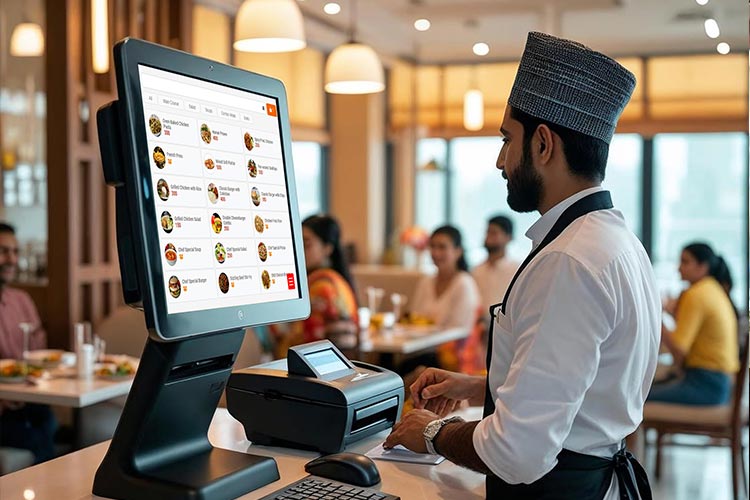
A notebook till still works in a quiet tea stall. It fails in a Dhaka rush, when two waiters write at once, or when load-shedding kills the Wi-Fi you were using for a cloud app. Restaurant technology in Bangladesh is not a US SaaS stack. It is a till that prints or displays kitchen tickets, a bill the owner can check later, and a device that still sells when the connection drops.
Quick answer: Restaurant technology in Bangladesh starts with a restaurant POS that bills, sends kitchen tickets, and still works in load-shedding. Add a kitchen display (KDS) and a QR menu after the till is stable. Dimdul installs Riser POS in Dhaka for ৳2,000 per month plus ৳5,000 setup. Aggregator ingest and mobile-wallet-in-till are not published on Riser POS.
Written by Dimdul, House 10, Road 4, Kaderabad Housing, Mohammadpur, Dhaka-1207. Last updated: 24 August 2026.
What is restaurant technology in Bangladesh?
Restaurant technology is the set of tools that take an order from the guest to the kitchen and into a sales record. In Bangladesh that usually means a restaurant POS, a kitchen display (KDS) or ticket printer, a QR menu, stock deducted as you sell, and offline POS so billing continues when 4G dies.
It is not a CRM dashboard, a courier GPS map, or a Foodpanda control panel inside the till. Those can exist as separate apps. Riser POS does not publish Foodpanda or Pathao ingest, bKash or Nagad in the till, or NBR Mushak 6.3 reports. If those lines are mandatory on day one, compare vendors that document them. Start with the restaurant POS buying checklist.
Grocery, clothing, and mobile shops should not use this restaurant stack. They belong on Riser POS Retail. Medicine shops belong on Riser POS Pharmacy.
How do you transform a restaurant with technology?
Do one floor job at a time. Buy the next tool only after staff can run the last one on a Friday night.
- Put every order on a restaurant POS. One ticket, one bill. Stop splitting the same table across a notebook and a phone calculator. Riser POS records dine-in, takeaway, and kitchen tickets on Windows, Android, or a tablet.
- Send the ticket to the kitchen. A kitchen display system (KDS) or a printer beats a shout across the pass. That is the first real change guests feel.
- Keep selling when the internet drops. Offline restaurant POS matters in load-shedding. Confirm it in a demo with the cable unplugged.
- Add a QR menu after prices are stable. A QR menu tied to the till updates without reprinting paper. Keep a few laminated menus when guest data is dead.
- Deduct stock as you sell. Inventory is useful once the till is trusted. It is noise if cashiers still skip items.
- Leave aggregators in their own apps unless a vendor documents ingest. Taking Foodpanda on a separate tablet is honest. Claiming the POS “automates delivery tracking” when it does not is not.
Hardware is separate. Many outlets start on a phone they already own, then add a thermal printer. See restaurant POS hardware in Bangladesh. Dimdul’s install includes domain, hosting, and training inside the ৳5,000 fee. There is no self-serve free trial.
Notebook vs restaurant technology vs aggregator-only
| Floor job | Notebook / Excel | Restaurant POS + KDS + QR | Aggregator tablet only |
|---|---|---|---|
| Bill in a rush | Easy to skip a line | Item tap, one open check | App bill; dine-in is still paper |
| Kitchen ticket | Shout or carbon | KDS or print | Packing for that app only |
| Load-shedding | Paper still works | Offline selling, then sync | App dies with the data |
| Owner check | Reconstruct at night | Sales record after sync | Only what the app paid you |
| Menu change | Reprint or scribble | Till + QR update together | Change in each app separately |
Paper is not a moral failure. It hides leaks. Restaurant technology makes the leak visible. An aggregator tablet is extra demand, not a replacement till for walk-in guests.
What should you not buy first?
Skip tools that need clean data you do not have yet.
- Heavy CRM and automated review bots. You do not need a loyalty engine before cashiers can close a bill without help.
- Courier GPS as a first purchase. If you pack from WhatsApp and a rider notebook, fix the ticket first. Cloud kitchens that live on delivery should read cloud kitchen POS in Bangladesh.
- US POS brands. Toast and Square assume US cards and US hardware. They are the wrong shortlist for Mohammadpur.
- Features Dimdul does not publish. Do not plan Riser POS around Mushak 6.3, bKash/Nagad in the till, or Foodpanda ingest. Those gaps are real. Local setup, published BDT price, offline billing, KDS, and QR menu are the published fit.
Staff still need written stations and a rush roster. Technology does not hire. It stops the fight over who shouted chilli. See managing restaurant staff.
What does this stack cost in Bangladesh?
As published in August 2026, Riser POS is ৳2,000 per month plus ৳5,000 installation (domain, hosting, training). Printers and cash drawers are extra. Full math: Riser POS price in Bangladesh.
Typical restaurant POS software in this market sits roughly ৳1,000–৳5,000 per outlet per month, depending on modules. Riser POS publishes one BDT number instead of “contact sales.” Dimdul, based in Mohammadpur, does the setup. If you are ready to install, use how to install restaurant POS in Bangladesh.
Next step
WhatsApp Dimdul for a kitchen walkthrough of Riser POS: 01538-004738. Ask to see a rush-hour ticket on the KDS with the internet unplugged, not a slide deck. Money page: Riser POS.
Frequently asked questions
What restaurant technology should I install first in Bangladesh?
Install a restaurant POS that bills and sends kitchen tickets, including offline selling. Add KDS if the kitchen still misses modifiers. Add a QR menu after prices stop changing every week. Do not start with CRM or courier tracking.
Does Riser POS include Foodpanda, Pathao, bKash, or Nagad?
No. Those integrations are not published. You can still take aggregator orders on their own tablets and close walk-in bills on Riser POS. If ingest or MFS-in-till is the buying reason, demo vendors that document those features.
Will restaurant technology work during load-shedding?
A notebook still works in the dark. A POS only helps if it can bill offline and you have light or a charged phone. Riser POS continues essential selling offline, then syncs, depending on setup. Pair it with a printer or KDS you can power.
How much does Dimdul restaurant technology cost?
Riser POS is ৳2,000 per month plus ৳5,000 installation as of August 2026, including domain, hosting, and training. Hardware is extra. There is no self-serve free trial.
Is this the same as Riser POS Retail?
No. This article is restaurant technology: orders, tables, KDS, QR menu. Retail is packed SKUs and shop billing. Pharmacy is medicine-shop billing. Do not mix the three product pages.